 Explainers
What Would Happen If Earth Stopped Spinning?
Earth’s spin feels so constant that it is easy to treat it as background scenery rather than one of the defining facts of our planet. Yet the ground b…
Read more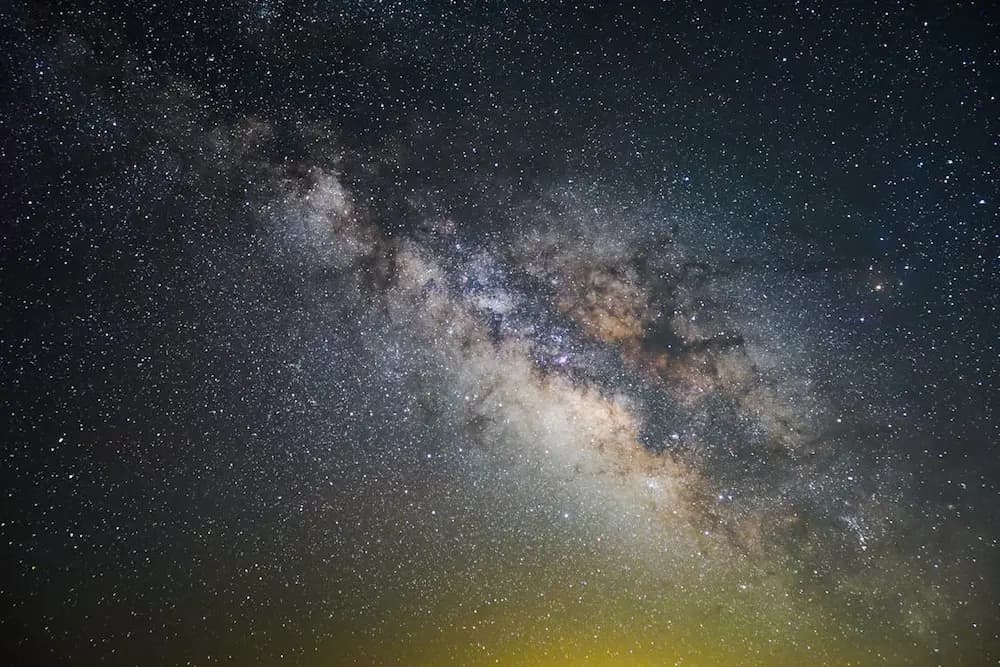
We live inside a galaxy so large that no one can step back and photograph it in a single frame. That is the central challenge of Milky Way astronomy: we are trying to map the forest while standing among the trees. Yet over decades, astronomers have assembled a remarkably clear picture of our home system by combining precision star maps with views in radio, infrared and X-ray light. The result is an inside-out portrait of a barred spiral galaxy — one with a bright central bulge, sweeping spiral arms, a vast dark halo and a restless history of growth through mergers.
The Milky Way is the galaxy that appears as a pale, milky band across a dark sky, a sight recognised long before Galileo showed that the glow is made of countless individual stars. Today it is understood as a rotating structure of gas, dust and hundreds of billions of stars, embedded in an even larger halo dominated by dark matter. It belongs to the Local Group, a small collection of galaxies centred on the Milky Way and the Andromeda Galaxy, rather than existing as some isolated island in space.
That broader context matters. As astronomers Joss Bland-Hawthorn and Ortwin Gerhard noted in their review of the Galaxy’s properties, the Milky Way is a benchmark for understanding disk galaxies because it is the only one we can study star by star, from ancient white dwarfs to luminous supergiants. In other words, what better laboratory could there be than the galaxy we already inhabit?

At its centre lies a bar-shaped bulge packed with older stars. This bulge has been described as boxy or peanut-shaped, and it surrounds the Milky Way’s central supermassive black hole, Sagittarius A*. Estimates in the supplied sources place that black hole at about 4 million times the mass of the Sun, making it the gravitational anchor of the whole system.
Beyond the bulge stretches the stellar disk, the part of the galaxy that produces most of the visible light and gives the Milky Way its familiar flattened form. The disk is roughly 100,000 light-years across and about 1,000 to 2,000 light-years thick, depending on which component is being described. Most naked-eye stars belong to this thin disk, where gas and dust gather into clouds that collapse to form new stars. Spiral arms thread through this region, including major arms such as Perseus and Scutum-Centaurus, along with smaller structures including the Local or Orion Arm, where the Sun resides.
| Milky Way feature | Approximate value |
|---|---|
| Galaxy type | Barred spiral |
| Diameter of stellar disk | About 100,000 light-years |
| Distance of the Sun from the centre | About 26,000 light-years |
| One galactic orbit of the Sun | Roughly 225–250 million years |
| Mass of Sagittarius A* | About 4 million Suns |
| Dark matter halo diameter | At least 600,000 light-years |
The thin disk is embedded in a thicker, fainter disk of older stars, and outside both lies the stellar halo, home to the oldest known stars in the Galaxy. Many of these halo stars are gathered into globular clusters, dense swarms containing about 100,000 stars each. Still farther out is the much more massive dark matter halo. Chandra’s overview notes that this invisible component outweighs all the Milky Way’s stars by about a factor of twenty, revealing itself only through gravity.
The Solar System sits in the outer part of the Milky Way, within the Orion Arm, around 26,000 light-years from the galactic centre. If the centre is a crowded downtown, we really do live in the suburbs. Even so, we are hardly stationary: the Sun is orbiting the centre of the Galaxy, completing one circuit in roughly 225 to 250 million years. The last time Earth was in this part of its galactic orbit, dinosaurs had only just begun to appear.
Working out that cosmic address took far more than ordinary stargazing. Dust lanes across the disk absorb visible light and hide huge sections of the Galaxy from direct view, which is why the Milky Way looks patchy in the night sky. To see through that obscuration, astronomers use multiwavelength astronomy. Infrared light penetrates dust far better than visible light. Radio observations trace cold gas, including the hydrogen that outlines galactic structure. X-rays, observed by NASA’s Chandra X-ray Observatory, expose the most violent environments — white dwarfs, neutron stars, black holes and multimillion-degree gas near the core.
That Chandra view of the Galactic Center is especially revealing. Its mosaic of the central region shows hundreds of compact stellar remnants immersed in hot gas, along with evidence that material is flowing outward from the centre into the wider Galaxy. The Milky Way’s core is not merely a static hub; it is a chemically active engine that can redistribute enriched gas into the surrounding disk.
The biggest leap in modern mapping, however, has come from the European Space Agency’s Gaia mission. By measuring the positions, distances and motions of more than a billion stars, Gaia transformed Milky Way studies from sketchwork into 3D cartography. It has sharpened the shape of the spiral arms, revealed that the disk is warped rather than perfectly flat, and allowed astronomers to reconstruct parts of the Galaxy’s past by tracking stellar motions backwards through time.

The Milky Way was not assembled in one calm moment. The sources describe a galaxy built over roughly 12 to 13.6 billion years through repeated mergers and continuing accretion of gas. Evidence from Gaia has shown that some stellar populations in our neighbourhood likely came from smaller galaxies that were torn apart and absorbed long ago. One intruder, the Sagittarius Dwarf Galaxy, has probably crossed the Milky Way’s disk several times, stirring star formation and perhaps helping shape some of the structure we see today.
This makes the Milky Way less like a finished object and more like a long-running process. Clouds of gas still fall inward. Satellite systems still orbit and interact. The halo still preserves traces of ancient collisions. Even the spiral arms may be comparatively short-lived features, forming and dispersing over timescales far shorter than the age of the Galaxy itself.
And then there is Andromeda. As part of the same Local Group, it is on a path that could eventually bring it into collision with the Milky Way in roughly 4 to 5 billion years. That future encounter would dramatically reshape both galaxies, though the vast distances between stars mean direct stellar collisions should remain rare. By then, of course, the Milky Way we know today — the glowing river across a dark sky, the barred spiral with a hidden black hole at its heart — will already have changed many times over.
For now, that is part of the wonder. Our galaxy is not just the backdrop to human history; it is a dynamic, rotating city of stars whose structure, motions and hidden components are finally coming into focus. And because we are inside it, every new map is also, in a very literal sense, a better map of home.
ExplainersEarth’s spin feels so constant that it is easy to treat it as background scenery rather than one of the defining facts of our planet. Yet the ground b…
Read more Explainers
Astronauts aboard the International Space Station seem to drift effortlessly, as if gravity has somehow been switched off. It is one of the most persi…
Read more Explainers
Mars looks red for a reason, but the familiar nickname hides a more interesting reality. The planet does not glow with one uniform scarlet hue, nor is…
Read more