 News
NewsNorthern Lights Alert Upgraded Across 23 States
The National Oceanic and Atmospheric Administration’s Space Weather Prediction Center upgraded its aurora outlook for Thursday, 4 June into Friday, 5 …
Read more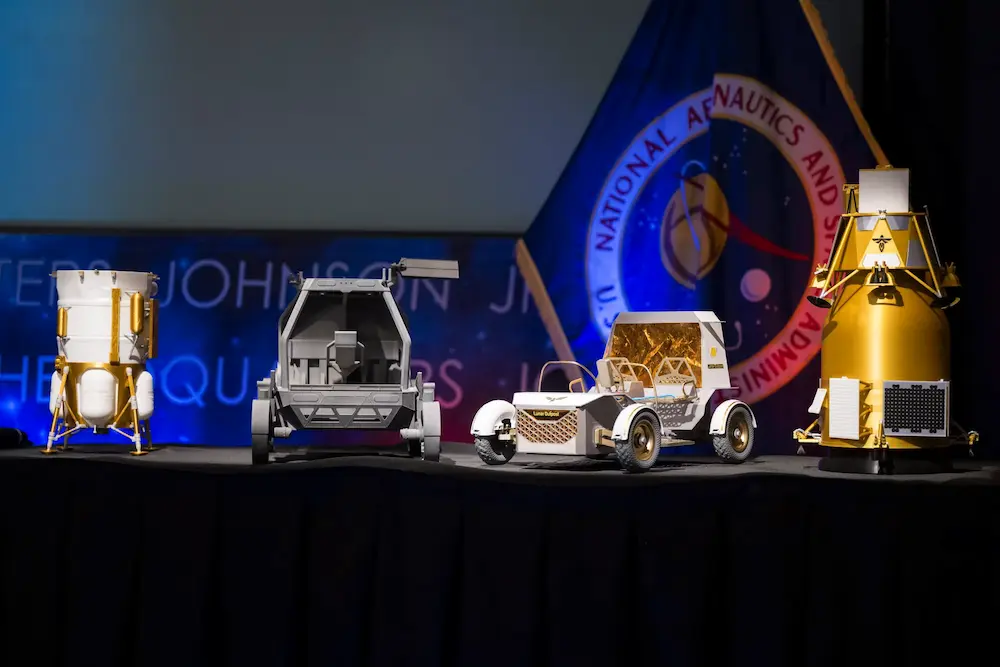
NASA has taken a more concrete step towards a sustained human foothold at the lunar south pole, laying out the first missions, rover contracts and cargo delivery plans under its evolving Moon Base initiative. The headline change is practical rather than symbolic: this is no longer framed as a handful of isolated lunar demonstrations, but as the early build-out of logistics, mobility and scouting systems intended to support later Artemis surface operations.
At a briefing on 26 May, NASA said the first round of Moon Base-linked awards and missions would centre on four companies: Astrolab and Lunar Outpost for lunar terrain vehicles, Blue Origin for rover delivery using its Blue Moon Mark 1 lander, and Firefly Aerospace for transporting MoonFall hopping drones to the Moon. In parallel, NASA also renamed three previously assigned Commercial Lunar Payload Services missions as Moon Base I, II and III, tying near-term robotic flights directly to the broader south polar campaign.
The shift matters because a base camp on the Moon will not begin with habitats and astronauts staying for long stretches. It begins with the less glamorous essentials: cargo moved reliably, terrain surveyed, landing sites assessed, and rovers proving they can work before crews arrive. How else do you build an outpost in one of the harshest places humans have ever tried to operate?
NASA Administrator Jared Isaacman framed it in expansive terms, calling the Moon Base “America’s and humanity’s first outpost on another celestial world”, and said each crewed and uncrewed mission would help NASA learn how to live and work on the lunar surface while preparing for more ambitious exploration beyond the Moon.
The most immediate awards went to the Lunar Terrain Vehicle effort, which NASA is now treating as a foundational service for Moon Base operations. Astrolab received $219 million and Lunar Outpost $220 million under Phase 1 High Achievability Mission task orders of the Lunar Terrain Vehicle Services contract. NASA described these as firm-fixed-price, performance-based milestone awards, with the selected companies expected over the next 18 months to finish designs, run crewed evaluations and qualify flight units.

Astrolab’s vehicle, called CLV-1, is adapted from the company’s FLEX architecture. NASA said it is designed to carry astronauts and supplies, support remote operations, stow compactly, weigh about 2,000 pounds and travel at more than 6 mph on level ground. Lunar Outpost’s Pegasus is a lighter rover derived from its earlier Eagle concept and designed to operate for up to a year, manually, autonomously or by teleoperation, at speeds above 9 mph.
Those rovers will not arrange their own ride to the Moon. Instead, NASA selected Blue Origin to deliver them through the Commercial Lunar Payload Services framework. The Blue Origin award includes $188 million for an initial phase, with options worth $280.4 million tied to the lander missions themselves. SpaceNews reported that NASA is working within revised rover mass and volume limits, including a mass cap of no more than one metric ton for deliveries under this approach.
| Provider | Role | Value disclosed | Target timing |
|---|---|---|---|
| Astrolab | Develop CLV-1 lunar terrain vehicle | $219 million | Flight units aimed for lunar deployment by 2028 |
| Lunar Outpost | Develop Pegasus lunar terrain vehicle | $220 million | Flight units aimed for lunar deployment by 2028 |
| Blue Origin | Deliver rovers with Blue Moon Mark 1 landers | $188 million base period, options worth $280.4 million | Rover deliveries before Artemis 4 in 2028 |
| Firefly Aerospace | Carry MoonFall drones to lunar orbit | NASA did not disclose; Firefly said JPL subcontract is $75 million | Launch targeted for 2028 |
The fourth company, Firefly Aerospace, was selected for MoonFall, a Jet Propulsion Laboratory-led mission designed to send drones to the lunar south pole. Firefly’s Elytra Dark spacecraft will transport the drones from Earth orbit to the Moon, releasing them from lunar orbit at an altitude of 50 kilometres, according to SpaceNews. NASA’s release described MoonFall as a four-drone mission, while NASA officials also said they were still studying whether the final mission would carry three or four. The broad aim is unchanged: these craft will hop across difficult terrain, gather high-resolution imagery and help assess possible Artemis landing zones. Launch is targeted for 2028.
NASA also defined the first three missions in the Moon Base sequence. Moon Base I, targeted for no earlier than autumn 2026, will use Blue Origin’s Blue Moon Mark 1 Endurance lander to deliver NASA payloads to Shackleton Connecting Ridge. Among them are the Stereo Cameras for Lunar Plume-Surface Studies instrument, which will examine how lander exhaust interacts with the surface, and the Laser Retroreflective Array, designed to help orbiting spacecraft determine location more precisely. The point is to gather operational data and reduce risk for later crewed Artemis landings in 2028.
Moon Base II, planned for later in 2026, will send more than 1,100 pounds of cargo aboard Astrobotic’s Griffin lander, including Astrolab’s FLIP rover. Rather than serving as the final crew rover, this mission is intended to mature mobility systems and inform how future Lunar Terrain Vehicle operations might work in real terrain.
Moon Base III, also targeted for 2026, will fly on Intuitive Machines’ Nova-C Trinity lander. Its main investigation, Lunar Vertex, is the first payload selected through NASA’s Payloads and Research Investigations on the Surface of the Moon initiative and will study lunar swirls, those enigmatic bright patches that hint at unusual surface evolution and material behaviour. NASA said the mission also includes payloads from the European Space Agency and the Korea Astronomy and Space Science Institute.
SpaceNews added that these renamed missions are not just branding exercises. NASA is applying added agency resources and test support to improve reliability, an unmistakable sign that the Moon Base campaign is being treated as operational groundwork rather than a loose collection of science flights.

The schedule remains ambitious, and NASA itself has left room for flexibility. These awards do not mean every selected provider now has guaranteed long-term flight opportunities. They are initial task orders, milestone-driven awards and option-based arrangements, with later missions still dependent on performance, competition and funding. NASA said it expects to announce more than a dozen Moon Base missions this year, along with additional CLPS 1.0 task awards and further opportunities under both CLPS 1.0 and the new CLPS 2.0 framework.
CLPS 2.0 is one of the more consequential developments tucked into this update. NASA released the final request for proposals on 15 May, with responses due by 30 June. The new structure gives the agency more flexibility: it can either buy turnkey delivery services or accept CLPS hardware for integration into NASA-led missions. That may sound procedural, but for a phased lunar base camp it matters enormously, because it opens the door to more tailored cargo and infrastructure missions as needs become clearer.
The next milestones to watch are straightforward: rover design finalisation, crewed evaluations, qualification of flight units, the first Blue Moon Mark 1 delivery this year, and later task order competitions for additional technologies. NASA also said planning is continuing for other base camp needs such as power, logistics and habitats, enabled by mid-sized cargo deliveries in the next generation of landers.
What emerges from this update is not a permanent Moon settlement suddenly taking shape, but something more credible: a phased architecture in which scouting drones, robotic cargo landers and dual-purpose rovers begin preparing the south pole before astronauts return. In lunar exploration, that kind of quiet groundwork is often where the future really starts.
NewsThe National Oceanic and Atmospheric Administration’s Space Weather Prediction Center upgraded its aurora outlook for Thursday, 4 June into Friday, 5 …
Read more News
NewsNASA’s James Webb Space Telescope has captured something remarkably rare: a detailed chemical fingerprint from an object that came from beyond our Sol…
Read more News
NewsTwo Roscosmos cosmonauts stepped back inside the International Space Station on 27 May 2026 after a tightly choreographed spacewalk that blended orbit…
Read more