 Explainers
What Is the Milky Way Galaxy? Everything You Need to Know
We live inside a galaxy so large that no one can step back and photograph it in a single frame. That is the central challenge of Milky Way astronomy: …
Read more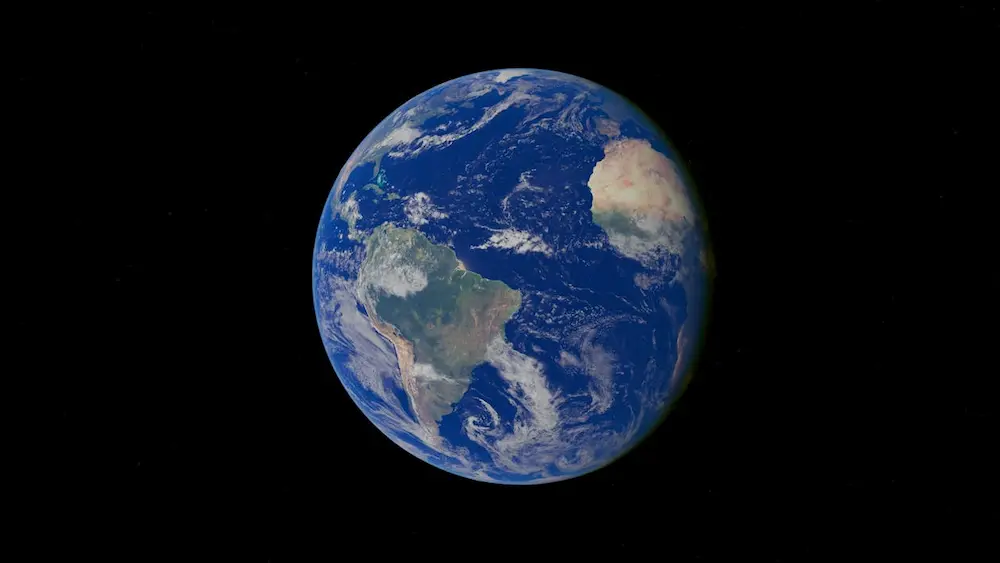
Earth’s spin feels so constant that it is easy to treat it as background scenery rather than one of the defining facts of our planet. Yet the ground beneath us is rotating at roughly 1,670 km/h at the equator, and that motion quietly shapes the length of the day, the height of the oceans, the paths of winds and even how much we weigh. So what would actually happen if Earth stopped spinning?
The short answer depends entirely on how it stopped. An abrupt halt would be a planetary disaster, because the oceans, atmosphere and almost everything not anchored to bedrock would keep moving eastward under inertia. A slowdown over immense spans of time would be less cinematic but no less transformative, remaking coastlines, climate and the basic rhythm of life. Those are really two different worlds, and physics treats them very differently.
If Earth’s solid body somehow stopped rotating in a moment, nothing else would conveniently freeze with it. At the equator, the surface is moving fastest, so the effects there would be most violent. Oceans would surge eastward, the atmosphere would continue racing around the planet, and the result would be catastrophic winds, continent-scale flooding and tsunamis. Buildings, transport networks and power systems would be devastated on a global scale.
Latitude matters. The farther you are from the equator, the slower your rotational speed already is, so the inertial carry-on would be less extreme toward the poles. But “less extreme” is not the same as safe. The atmosphere and seas are linked systems, and a sudden stop would scramble both.
There is also a subtler effect: Earth’s spin slightly reduces effective gravity at the equator through centrifugal lift. Remove that, and you would weigh about 0.3% more. At the same time, the planet’s equatorial bulge, created by rotation over geological time, would no longer be supported. Earth is not a perfect sphere now; it swells around the middle. If rotation vanished, that shape would begin to relax, and the oceans would eventually respond.

| Feature | Earth today | If rotation stopped |
|---|---|---|
| Equatorial surface speed | About 1,670 km/h | Drops to zero |
| Day length | 24 hours | One day equals one year |
| Effective gravity at equator | Slightly reduced by spin | About 0.3% higher body weight |
| Planet shape | Bulging at the equator | Bulge would relax over time |
One caveat belongs here, because it is often oversimplified. Earth’s magnetic field is tied to motions in the core and to rotation, but an abrupt halt would not necessarily switch the field off overnight. The long-term outcome is uncertain, which is a very different statement from saying nothing would change.
This version is less apocalyptic and more profound. Earth is already slowing, though only by tiny amounts: lunar tides are gradually lengthening the day by milliseconds per century. Push that process to an extreme over unimaginable timescales, and the planet would settle into a new balance.
The most dramatic shift would be geographical. Today, rotation helps maintain the equatorial bulge, and ocean water is distributed accordingly. Without spin, that bulge would ease back. Water would migrate toward the poles, leaving more land exposed around the equator and building vast polar seas. The map of Earth would be redrawn not by a single catastrophe, but by slow planetary reshaping.
The daily cycle would become almost unrecognisable. Instead of a 24-hour day, a non-rotating Earth would effectively experience one daylight period and one night each year as it continued orbiting the Sun. That means long months of heating followed by long months of cooling. Some regions would endure searing daytime conditions, while others would spend extended periods in deep cold. How would ecosystems cope with such extremes? Many would not in any familiar form.
Weather would also be rebuilt from first principles. The Coriolis effect — the apparent deflection of moving air and water caused by Earth’s rotation — is one of the hidden architects of modern climate. It helps organise jet streams, influences ocean currents and is essential to the way hurricanes spin. Remove it, and those familiar patterns disappear. Winds would still blow, because sunlight would still heat the planet unevenly, but they would flow in very different ways. Ocean circulation would be restructured too, with consequences rippling through heat transport, rainfall and seasonal patterns.

Because Earth spins, we live on a world where weather systems curve, trade winds form and the upper atmosphere supports organised bands such as the jet streams. Strip out rotation, and the atmosphere becomes a different machine. Hurricanes as we know them would not exist, because their rotation depends on the Coriolis effect. That does not mean calm skies — only that the violence would take other forms.
Space technology would have to adapt as well. Geostationary satellites work because they orbit at just the right rate to match Earth’s 24-hour rotation, appearing fixed over one point on the equator. Without that spin, there would be no true geostationary orbit in the familiar sense. Satellite networks could still exist, but operations, coverage strategies and orbital choices would all change.
Perhaps the most striking lesson in this thought experiment is not the spectacle of destruction, but how deeply rotation is woven into ordinary life. It shapes sea level, air flow, planetary form and even the faint difference in your weight depending on where you stand. Earth’s spin can seem abstract because we do not feel it directly, yet nearly every large-scale system on the planet bears its signature. Stop that motion suddenly, and the result is immediate chaos. Let it fade over eons, and the world becomes alien in slower, quieter ways.
ExplainersWe live inside a galaxy so large that no one can step back and photograph it in a single frame. That is the central challenge of Milky Way astronomy: …
Read more Explainers
Astronauts aboard the International Space Station seem to drift effortlessly, as if gravity has somehow been switched off. It is one of the most persi…
Read more Explainers
Mars looks red for a reason, but the familiar nickname hides a more interesting reality. The planet does not glow with one uniform scarlet hue, nor is…
Read more