 News
NewsNorthern Lights Alert Upgraded Across 23 States
The National Oceanic and Atmospheric Administration’s Space Weather Prediction Center upgraded its aurora outlook for Thursday, 4 June into Friday, 5 …
Read more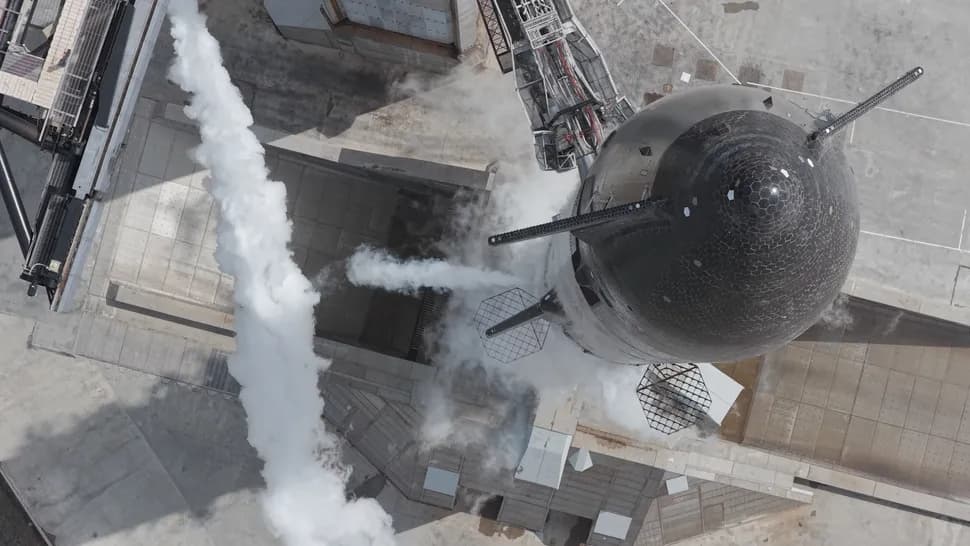
SpaceX has carried out the first full propellant loading of its upgraded Starship Version 3, a major preflight milestone that brings the company’s next giant test mission into sharper focus. The rehearsal took place at Starbase in South Texas on 11 May 2026, with the fully stacked vehicle loaded with super-chilled liquid oxygen and liquid methane for the first time.
For anyone wondering what this means in practical terms, this was the moment when Starship V3 stopped being merely the latest hardware on the pad and started looking like a rocket system moving into genuine launch preparation. SpaceX described the operation as a launch rehearsal during a flight-like countdown, saying that more than 5,000 metric tonnes of propellant were loaded into the stacked Starship upper stage and Super Heavy booster.
The company also released new photos of the operation, showing the towering stainless-steel vehicle on the launch pad, frosted and venting as cryogenic propellants flowed aboard. Those images captured the scale of the step rather well: this is now the tallest rocket ever assembled, at about 408 feet (124.4 metres), slightly taller than the previous V2 configuration.
In rocket testing, a full fuelling exercise is one of the clearest signs that a vehicle is edging towards flight. It is often referred to as a wet dress rehearsal, though the most useful way to think about it is as a full systems check under near-launch conditions. Tanks are filled, countdown procedures are exercised and engineers get to see how the vehicle and ground systems behave when enormous volumes of cryogenic propellant are involved. That may sound procedural, but what could be more revealing for a methane-fuelled super-heavy launcher than seeing whether the whole stack can be loaded cleanly and on schedule?

For Starship V3, this first fuelling is especially significant because Flight 12 is set to mark the debut of a new variant rather than another outing for the earlier designs. According to the source material, V3 is the first version of Starship described as being capable of exploring deep space. That makes this more than a routine checkpoint in an already fast-moving test campaign; it is the beginning of a transition to a more ambitious phase of the programme.
| Starship V3 test milestone | Detail |
|---|---|
| Location | Starbase, South Texas |
| Date of launch rehearsal | 11 May 2026 |
| Propellant loaded | More than 5,000 metric tonnes |
| Vehicle height | 408 feet (124.4 metres) |
| Upcoming mission | Flight 12 |
SpaceX had already completed static-fire engine tests with both the Ship upper stage and the Super Heavy booster before this rehearsal, clearing the way for a full-stack fuelling run. The company had not announced an official launch date at the time of reporting, though the test flight could come as soon as 15 May, according to the cited launch-tracking information.
Starship first flew in April 2023, when its debut integrated test ended in a dramatic explosion only minutes after liftoff. Since then, the programme has advanced through 11 suborbital test missions, with the most recent having taken place in October 2025. The last two flights were reported as completely successful, a notable contrast with the fiery setbacks that defined the programme’s earliest public tests.
Every one of those missions used V1 or V2 hardware. Flight 12 therefore stands apart as the first real test of the upgraded V3 architecture in integrated form. That distinction matters because Starship is not being built for a single role. SpaceX says the vehicle is intended to support settlement ambitions for the Moon and Mars, help complete deployment of the Starlink broadband constellation and take on a broad range of other spaceflight jobs. In other words, the same rocket family is supposed to bridge near-Earth commercial work and much farther-flung exploration.
That breadth explains why each technical milestone now carries more weight than a typical test-stand update. A successful fuelling rehearsal does not guarantee a clean launch, of course, but it does suggest that ground systems, tanking procedures and vehicle integration are progressing in step.

The immediate next point of interest is straightforward: Flight 12. If it flies successfully, V3 will move from a promising upgrade path to a tested system with real momentum behind it. If problems emerge, they will shape how quickly SpaceX can push the vehicle towards the harder objectives that still remain.
And those harder objectives are substantial. The source notes that Starship still lacks a life-support system, has not yet reached orbit and has not demonstrated off-Earth propellant transfer. Those are not minor boxes left unticked at the edge of the programme; they are central capabilities for any spacecraft meant to support deep-space operations or human landings beyond Earth orbit.
There is also a NASA dimension. The agency selected Starship as one of the two crewed lunar landers for the Artemis programme, alongside Blue Origin’s Blue Moon. The article says Artemis 3 could launch as soon as next year on a mission designed to test rendezvous and docking operations in low Earth orbit using the Orion spacecraft and Starship and/or Blue Moon. If that goes well, Artemis 4 could place astronauts near the lunar south pole as early as late 2028.
So yes, this latest tanking test was a ground operation rather than a launch. Yet in the logic of rocket development, these are the moments when future missions begin to feel less abstract. A towering vehicle at the pad, loaded with thousands of tonnes of cryogenic propellant, is no longer just a concept with gleaming metal skin. It is a machine being asked, step by step, to prove it can carry human spaceflight into a far more demanding era.
NewsThe National Oceanic and Atmospheric Administration’s Space Weather Prediction Center upgraded its aurora outlook for Thursday, 4 June into Friday, 5 …
Read more News
NewsNASA’s James Webb Space Telescope has captured something remarkably rare: a detailed chemical fingerprint from an object that came from beyond our Sol…
Read more News
NewsTwo Roscosmos cosmonauts stepped back inside the International Space Station on 27 May 2026 after a tightly choreographed spacewalk that blended orbit…
Read more