 News
NewsNorthern Lights Alert Upgraded Across 23 States
The National Oceanic and Atmospheric Administration’s Space Weather Prediction Center upgraded its aurora outlook for Thursday, 4 June into Friday, 5 …
Read more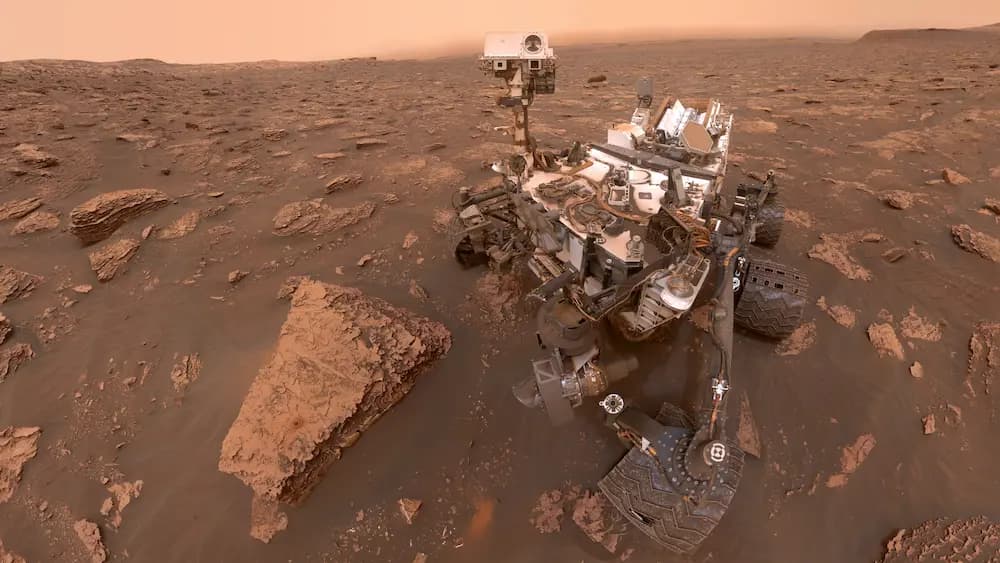
NASA’s Curiosity rover has spent nearly 14 years exploring Gale Crater, drilling into Martian rocks to uncover clues about ancient habitability. In late April and early May 2026, that routine work took an unexpectedly dramatic turn when a drilled rock nicknamed Atacama came loose from the ground and stayed attached to the rover’s drill assembly.
The result was one of those wonderfully strange moments that only planetary exploration seems to deliver: a veteran rover on another world, holding a stubborn chunk of Mars on the end of its robotic arm while engineers on Earth worked through a careful plan to free it. NASA has now released images and animations showing the episode, including a close-up view of the rock after it finally fell and fractured on the surface.
For anyone wondering what actually happened, the short answer is this: Curiosity drilled into Atacama on April 25, 2026, then accidentally pulled the whole rock out of the ground as it withdrew its arm. The rock remained caught on the fixed sleeve around the rotating drill bit. Several attempts followed before engineers successfully dislodged it on May 1, with no lasting damage reported.

Atacama was no tiny grain of dust. NASA estimated the rock at about 1.5 feet across at its base and roughly 6 inches thick, with an Earth weight of around 28.6 pounds, or 13 kilograms. Curiosity had drilled into it to collect a powdered sample, a standard but essential part of the rover’s scientific workflow.
What made this event unusual was not that drilling disturbed the target. Curiosity has fractured rocks before, and layers have separated during drilling operations. But according to NASA, this was the first time a whole rock stayed attached to the drill sleeve itself. That distinction matters, because the drill area needs to remain clear for sampling and analysis.
The first response was measured rather than dramatic. Engineers commanded the drill to vibrate, hoping the motion would shake the rock free. It did not. A later attempt on April 29 involved repositioning the robotic arm and vibrating the drill again. Images showed sand spilling from the rock, suggesting some movement, but Atacama still held on. How do you remove a rock from a robot arm when the robot is millions of miles away? Slowly, methodically and with a great deal of patience.
| Date | Event |
|---|---|
| April 25, 2026 | Curiosity drilled Atacama and accidentally pulled the rock loose from the surface. |
| April 29, 2026 | Team repositioned the arm and tried drill vibration again; sand fell away, but the rock stayed stuck. |
| May 1, 2026 | Engineers used steeper angles, rotation and vibration; the rock came free and broke on impact. |
| May 6, 2026 | Curiosity’s Mast Camera captured a close-up mosaic of the broken rock on the ground. |
The successful effort came on May 1. This time, the team combined several actions: placing the drill at steeper angles, rotating and vibrating the drill, and spinning the drill bit. NASA had expected the manoeuvre might need to be repeated, but the first round was enough. The rock detached, fell to the Martian ground and broke apart, leaving the drill assembly clear again.
That final image is especially revealing. A mosaic taken by Curiosity’s Mast Camera on May 6 shows Atacama on the ground in pieces, with the circular drill hole still clearly visible. The colour was approximately white-balanced by NASA to resemble daytime lighting on Earth, making the fractured target easier to interpret visually.
The episode also offered a neat reminder of how much rover operations depend on remote fieldcraft. Curiosity’s team cannot react instantly. Commands are sent from Earth, then everyone waits to see what Mars delivers back. That cadence rewards caution, and in this case the cautious approach paid off.
Just as revealing is the fact that Curiosity handled the problem at all. This is a rover that launched in 2011 and landed in 2012, yet it is still drilling, imaging and adapting to the unexpected in one of the most demanding environments any robot has ever faced.

On the surface, a stuck rock may sound like a small operational oddity. In practice, the drill is central to Curiosity’s mission. It allows the rover to collect powdered rock from inside Martian targets, where chemistry and mineralogy can reveal whether ancient environments in Gale Crater could once have supported microbial life.
That broader context is what makes this more than a charming mechanical mishap. Curiosity has already found mineral and chemical evidence that Mars once hosted habitable environments, and drilling remains one of its most powerful tools for building that picture. Keeping the drill area clear is not a side concern; it is part of protecting the rover’s core science capability.
There is also a quiet operational lesson here. Space missions are often celebrated for their major discoveries, but they survive on countless small recoveries like this one. A rock gets lodged in the wrong place, the science plan pauses, engineers test options, images come down, and a solution emerges. That rhythm rarely makes headlines, yet it is the reality of exploration.
In this case, the outcome was reassuringly clean: Atacama came off, the hardware remained healthy, and Curiosity showed once again why it remains such a formidable explorer on Mount Sharp. Even after all these years on Mars, it is still capable of surprising the team — and all of us watching from Earth.
NewsThe National Oceanic and Atmospheric Administration’s Space Weather Prediction Center upgraded its aurora outlook for Thursday, 4 June into Friday, 5 …
Read more News
NewsNASA’s James Webb Space Telescope has captured something remarkably rare: a detailed chemical fingerprint from an object that came from beyond our Sol…
Read more News
NewsTwo Roscosmos cosmonauts stepped back inside the International Space Station on 27 May 2026 after a tightly choreographed spacewalk that blended orbit…
Read more