 News
NewsNorthern Lights Alert Upgraded Across 23 States
The National Oceanic and Atmospheric Administration’s Space Weather Prediction Center upgraded its aurora outlook for Thursday, 4 June into Friday, 5 …
Read more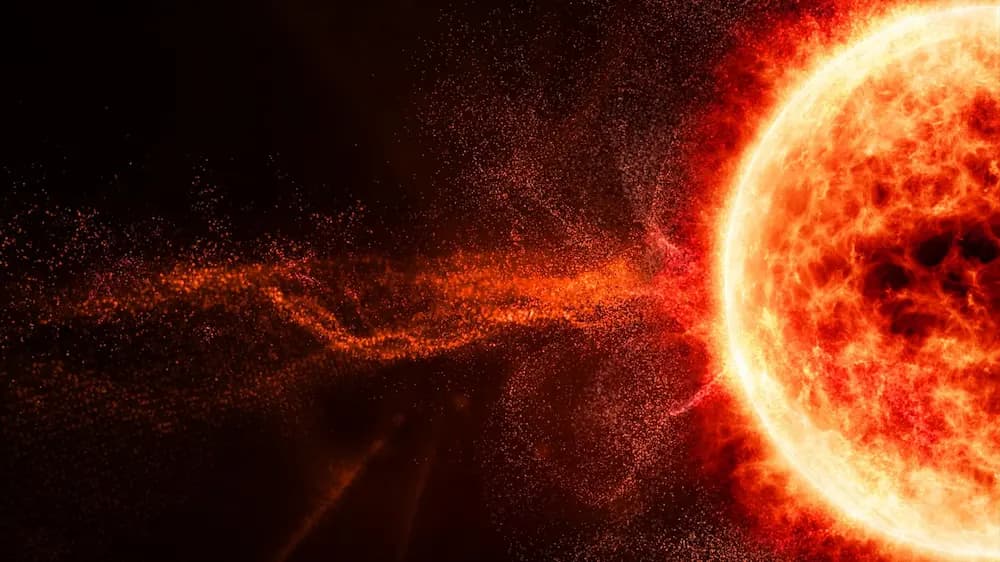
A strong solar eruption on 10 May has raised the prospect of auroras at high latitudes as charged material from the Sun sweeps past Earth. The key point for skywatchers is simple: forecasters at NOAA’s Space Weather Prediction Center and the U.K. Met Office said a coronal mass ejection, or CME, from the blast could deliver a glancing blow around early 13 May, potentially triggering minor geomagnetic storm conditions.
The eruption came from sunspot region AR4436 and peaked at 13:39 UTC as an M5.7-class solar flare. That put it firmly in the Sun’s powerful M category, one step below the most intense X-class events. At the time, the flare caused radio blackouts over the Atlantic on the sunlit side of Earth, according to NOAA, because bursts of X-ray and ultraviolet radiation rapidly disturbed the upper atmosphere and interfered with high-frequency radio signals.
For most readers, though, the more immediate question is: will it paint the sky with northern lights? Possibly, but with limits. This was not forecast to be anything like the extraordinary G5 storm of May 2024. Instead, agencies pointed to the chance of a much weaker G1 geomagnetic storm, enough to enhance aurora visibility across favoured northern locations in the northern US and the UK, especially under dark, clear skies.

The flare and CME were linked, but they are not the same thing. A solar flare is an intense flash of radiation that reaches Earth in minutes and can trigger immediate radio problems. A coronal mass ejection is a huge cloud of magnetised solar plasma that takes much longer to travel through space and is the main driver of geomagnetic storms and auroras.
Images from NASA’s Solar Dynamics Observatory showed the eruption tearing through the Sun’s outer atmosphere and leaving behind what some reports described as a giant cavity. That dramatic wording can sound alarming, yet it does not mean a literal hole was punched into the solar surface. In this case, the feature was associated with material blasted outward during the eruption from AR4436.
What makes AR4436 especially interesting is its position. When the flare erupted, the sunspot region was rotating into Earth’s so-called strike zone on the Sun’s north-eastern limb. In other words, it was becoming better aligned with our planet. Both NOAA’s Space Weather Prediction Center and the U.K. Met Office warned that as AR4436 and AR4432 continue to evolve, additional M-class flares and perhaps even X-class eruptions remain possible.
| Event | Detail |
|---|---|
| Solar flare | M5.7-class flare from AR4436 |
| Peak time | 10 May 2026, 13:39 UTC |
| Immediate effect | Radio blackout over the Atlantic on Earth’s sunlit side |
| CME forecast | Mostly misses Earth, but a glancing blow possible |
| Expected arrival | Around early 13 May |
| Likely geomagnetic level | Minor G1 storm, if Earth is brushed by the CME |
Because the CME was expected to pass mainly east of Earth, the aurora outlook remained modest rather than spectacular. If the edge of the solar plume connected effectively with Earth’s magnetic field, auroras could brighten across polar and subpolar regions, with some chance of visibility farther south than usual in parts of the northern US and the UK. That is still a conditional forecast, not a promise. A small change in the CME’s path or magnetic orientation can make the difference between a decent show and a non-event.
The non-visual effects are clearer. NOAA said the flare itself disrupted high-frequency communications used by aviators, mariners and amateur radio operators. If a G1 storm developed from the CME, official expectations pointed more towards minor space-weather consequences: some weak power-grid fluctuations at high latitudes, occasional effects on satellite operations and slight degradation to radio propagation. Claims of major infrastructure danger would run well ahead of the forecast.
There is a broader pattern here. The Sun is near the peak of Solar Cycle 25, and that means more active sunspot regions, more frequent eruptions and more nights when aurora alerts suddenly become relevant far beyond the Arctic. AR4436 had already drawn attention because reports said it had produced several significant CMEs while on the Sun’s far side. Now that it has rotated closer into view, forecasters are watching it very closely.

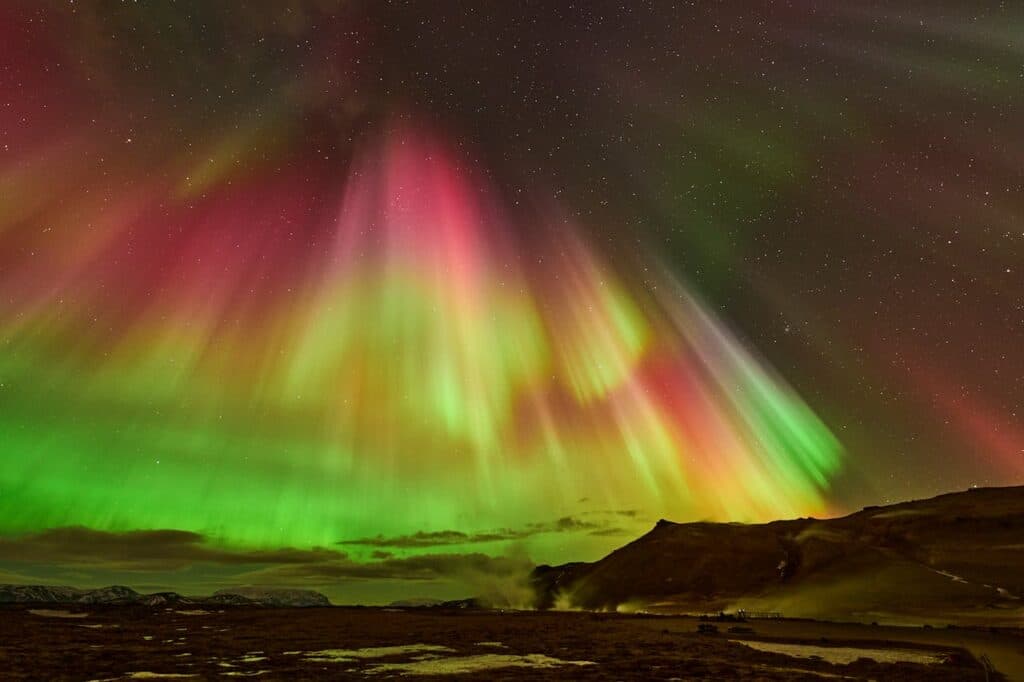
If you are hoping to catch the lights, the best strategy is refreshingly old-fashioned: get somewhere dark, escape city glare, and keep an eye on cloud cover. Observers in the northern hemisphere should look towards the northern horizon, especially around local midnight, though strong displays can spread much higher. In the southern hemisphere, aurora watchers would look south.
For photography, a smartphone in night mode can sometimes record more colour than the naked eye sees at first glance. A camera or DSLR works even better with a steady tripod and long exposures. The sky may initially look like a pale arc or faint glow before richer greens and magentas emerge in images.
Most of all, keep expectations flexible. Space-weather forecasts can shift quickly as new solar-wind data arrives, especially with a glancing CME rather than a direct hit. For the latest outlook, NOAA’s Space Weather Prediction Center and the U.K. Met Office remain the best guides. Even a minor storm can deliver a memorable sky, and that is part of the thrill: a reminder that our calm blue world still lives in the atmosphere of a star.
NewsThe National Oceanic and Atmospheric Administration’s Space Weather Prediction Center upgraded its aurora outlook for Thursday, 4 June into Friday, 5 …
Read more News
NewsNASA’s James Webb Space Telescope has captured something remarkably rare: a detailed chemical fingerprint from an object that came from beyond our Sol…
Read more News
NewsTwo Roscosmos cosmonauts stepped back inside the International Space Station on 27 May 2026 after a tightly choreographed spacewalk that blended orbit…
Read more