 Science
Dark Matter Explained: The Biggest Mystery in the Universe
Dark matter is one of astronomy’s strangest facts: the Universe appears to be built on something we cannot see. It does not shine, reflect or absorb l…
Read more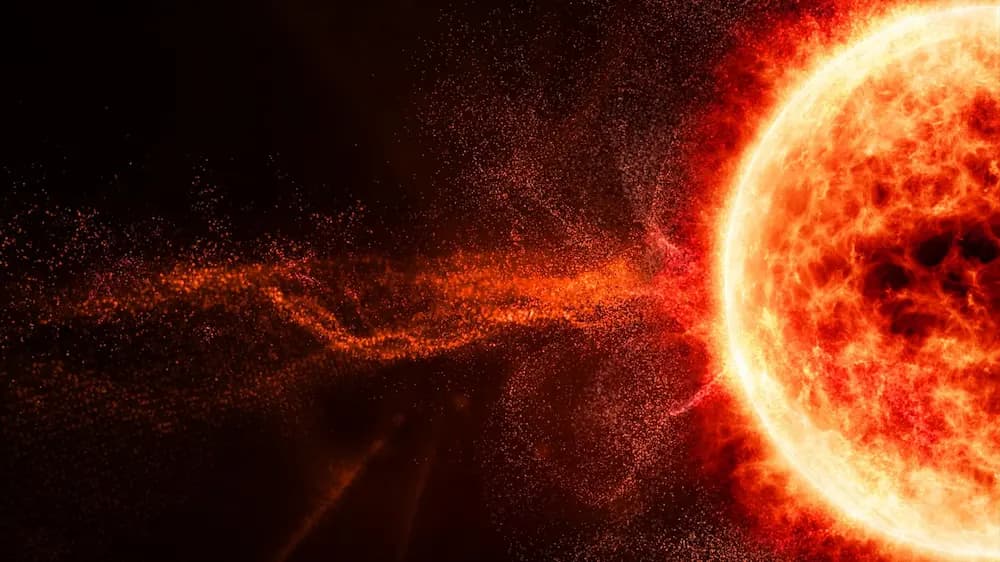
The solar wind is the Sun’s constant outflow of electrically charged particles, an invisible stream that fills the solar system every day. For anyone searching what it is and why it matters, the short answer is this: it is mostly electrons and protons racing away from the Sun at roughly 300 to 800 kilometres per second, carrying the Sun’s magnetic field with them. Most of the time that flow is simply part of the background environment of space. Yet when its speed, density and magnetic orientation line up in the wrong way for Earth, the result can be geomagnetic storms, vivid auroras and disruptions that ripple into modern technology.
That contrast is what makes the solar wind so fascinating. It is both ordinary and dramatic, a permanent feature of our star’s behaviour and the engine behind some of space weather’s most consequential moments. It also differs from more explosive solar events. Solar flares are sudden bursts of radiation, while coronal mass ejections, or CMEs, hurl giant clouds of plasma and magnetic field into space. The solar wind, by comparison, never really stops. It is the medium through which those eruptions travel, and sometimes the quiet wind itself is enough to stir trouble at Earth.
The solar wind is born in the corona, the Sun’s outer atmosphere, where temperatures soar far above those at the visible surface. That extreme heating gives particles enough energy to escape the Sun’s gravity. They stream outward along open magnetic field lines, forming a flow that expands through interplanetary space. Scientists distinguish between fast and slow solar wind because they come from different magnetic environments on the Sun. Fast wind is linked to coronal holes, darker regions where magnetic field lines open more directly into space. Slow wind tends to emerge from more complex regions where the magnetic geometry is tangled and changing.
As that plasma spreads outward, it drags the Sun’s magnetic field with it. This is known as the interplanetary magnetic field, and it is central to whether Earth experiences little more than a passing breeze or something far more disruptive. The key detail is direction. When the interplanetary magnetic field points southward, opposite to Earth’s northward-facing magnetic field on the dayside, the two can connect efficiently. That magnetic coupling allows energy and particles from the solar wind to pour into near-Earth space far more readily. What looks empty between the planets is anything but empty.
| Solar wind feature | Typical behaviour | Why it matters |
|---|---|---|
| Particle makeup | Mostly electrons and protons | Creates a moving plasma environment throughout the solar system |
| Speed | About 300–800 km/s | Faster streams can intensify geomagnetic activity |
| Fast wind source | Coronal holes, along open magnetic field lines | Often tied to recurring space weather conditions |
| Slow wind source | More complex magnetic regions | Can vary in structure and complicate forecasts |
| Critical magnetic condition | Southward interplanetary magnetic field | Couples strongly to Earth’s magnetosphere and can trigger storms |
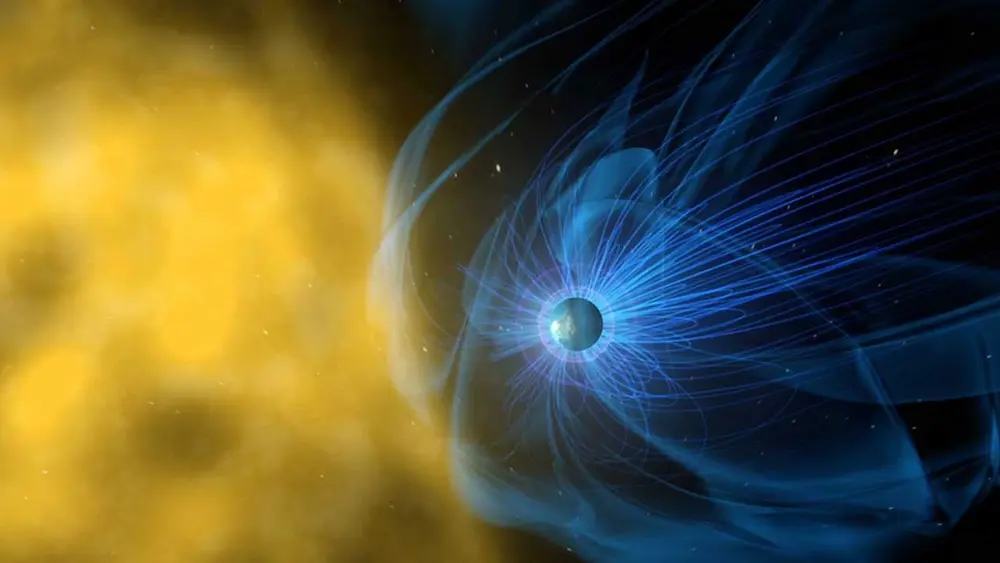
Earth is not defenceless. Its magnetic field carves out a protective bubble called the magnetosphere, forcing the supersonic solar wind to slow abruptly at a bow shock before it flows around the planet. But that shield is dynamic, not rigid. When solar wind conditions become favourable for magnetic coupling, Earth’s magnetosphere is compressed on the dayside and stretched into a long magnetotail on the nightside. Energy builds, magnetic fields reconnect and charged particles are funnelled toward the polar atmosphere.
That is when the sky can answer with auroras. Greens, reds and purples shimmer as particles collide with atmospheric gases, turning a magnetospheric disturbance into something humans can see. Yet the same process that paints the sky can interfere with the systems civilisation now takes for granted. Satellites can experience charging and increased drag, GPS accuracy can degrade, radio communications can falter and aviation routes over polar regions can be affected. Under stronger geomagnetic storm conditions, power grids can also come under strain. Space weather is cosmic physics made practical.
Solar activity rises and falls with the solar cycle, so the behaviour of the wind and the likelihood of disturbances do not stay constant. That is why monitoring matters. Agencies and missions including NOAA’s Space Weather Prediction Center, NASA’s Deep Space Climate Observatory, NASA’s Advanced Composition Explorer, the European Space Agency and NASA’s Solar and Heliospheric Observatory, and the European Space Agency’s Solar Orbiter help watch the Sun and sample the solar wind before it sweeps past Earth. Those observations are essential for forecasting conditions that can change rapidly.
The deeper story is one of scientific persistence. Eugene Parker predicted the existence of the solar wind long before spacecraft could measure it directly, arguing that the hot corona should expand continuously into space. That idea was once controversial, but it became one of heliophysics’ foundational insights. Today his name flies with NASA’s Parker Solar Probe, a mission that has travelled through the Sun’s outer atmosphere and into the birthplace of the wind itself.
Its measurements have revealed new structure and complexity in this supposedly familiar flow, sharpening the picture of how the corona feeds the heliosphere. That matters not only to solar physicists, but to everyone living inside the Sun’s reach. The solar wind sculpts comet tails, shapes planetary magnetic environments and defines the boundary conditions of the entire solar system. Near Earth, it can remain a faint background whisper for days, then suddenly become the driver of a geomagnetic storm. How often do we get a reminder that our world sits inside the atmosphere of a star?
Seen that way, the solar wind is more than a technical term. It is the Sun made tangible across millions of kilometres: an unceasing magnetic breeze, born in the corona, carrying both beauty and risk. Understanding it better is not just an exercise in astrophysics. It is part of learning how to live with a restless star.
ScienceDark matter is one of astronomy’s strangest facts: the Universe appears to be built on something we cannot see. It does not shine, reflect or absorb l…
Read more Science
Black holes were once the strangest implication of Albert Einstein’s general theory of relativity: regions of space where gravity becomes so intense t…
Read more