 Science
Dark Matter Explained: The Biggest Mystery in the Universe
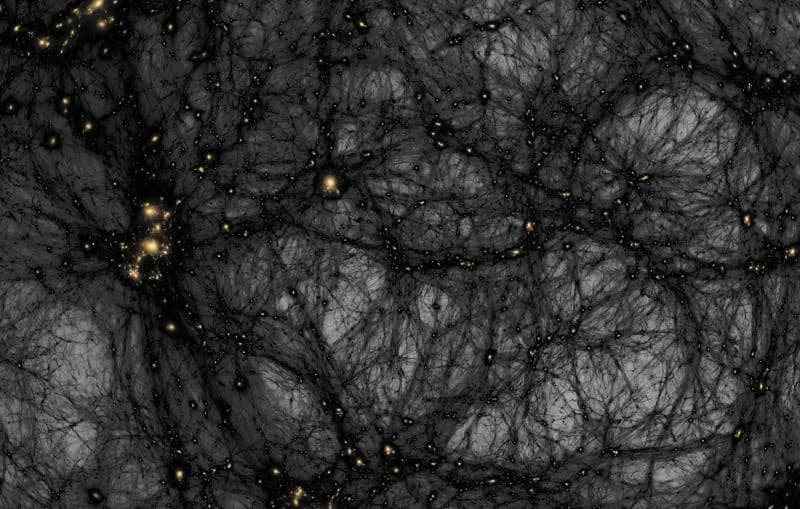
Dark matter is one of astronomy’s strangest facts: the Universe appears to be built on something we cannot see. It does not shine, reflect or absorb l…
Read more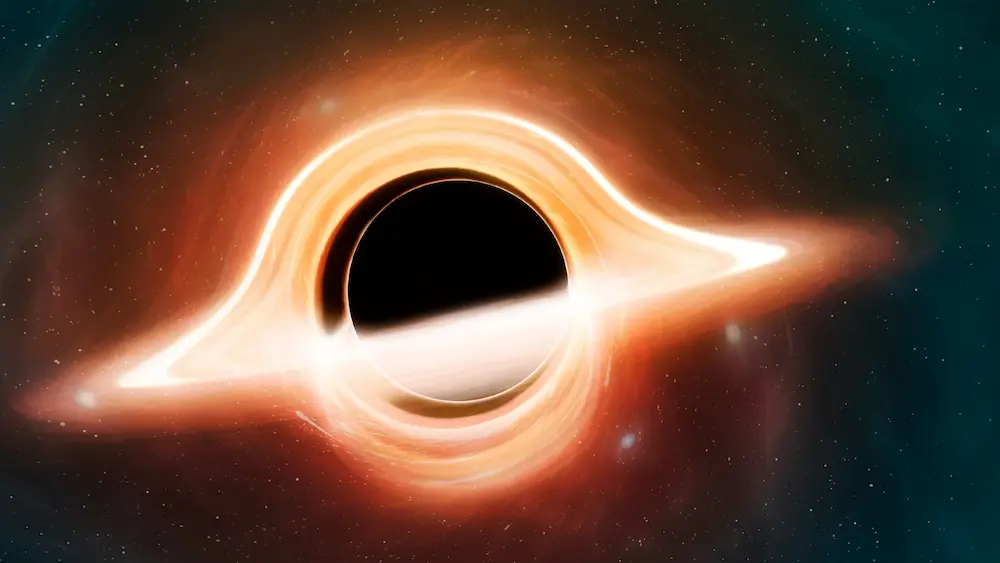
Black holes were once the strangest implication of Albert Einstein’s general theory of relativity: regions of space where gravity becomes so intense that nothing crossing a boundary called the event horizon can get back out, not even light. For decades, that sounded almost too extreme to be real. Yet modern astronomy has turned them from mathematical oddities into some of the best-studied objects in the cosmos. The story is less a sudden revelation than a long scientific detective case, built from theory, painstaking observations and, eventually, direct images and ripples in spacetime itself.
The 2020 Nobel Prize in Physics captured that arc beautifully. The Royal Swedish Academy of Sciences awarded half the prize to Roger Penrose for showing in 1965 that black hole formation is a robust consequence of general relativity, and the other half jointly to Reinhard Genzel and Andrea Ghez for uncovering the invisible, supermassive object at the heart of the Milky Way. Their work did not merely celebrate black holes as dramatic cosmic curiosities; it marked the point where one of relativity’s boldest predictions had become part of astronomy’s observational bedrock.
At the centre of the idea lies a profound tension in physics. General relativity describes how matter and energy curve spacetime, and in extreme collapse that curvature can become so severe that a singularity appears in the mathematics, a point where our known laws no longer give a workable description. Physicists use the word carefully: it signals the breakdown of current theory, not a neat, fully understood object. Even so, the event horizon around such a collapsed mass is a more concrete concept. It is the one-way boundary that defines a black hole.
And despite their fearsome reputation, black holes are not cosmic vacuum cleaners. Far from the event horizon, their gravity behaves like that of any other object with the same mass. If the Sun were somehow replaced by a black hole of equal mass, Earth’s orbit would remain the same, though our planet would of course freeze in darkness. The real drama begins only when matter gets very close.
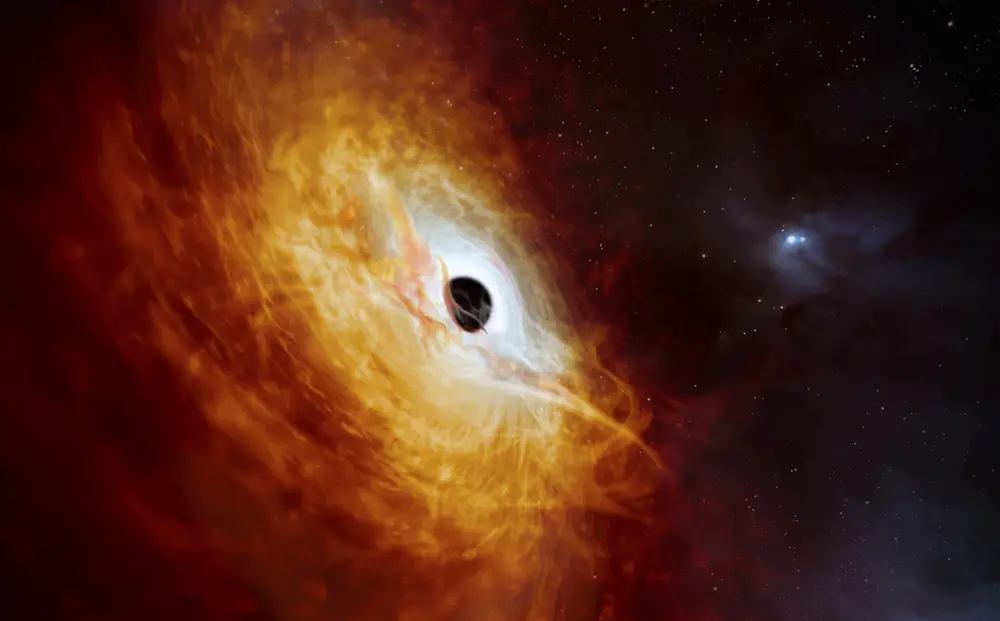
Einstein himself did not believe black holes would truly exist in nature. Penrose changed that picture. Using powerful mathematical methods, he showed that once a sufficiently massive object collapses under gravity, black hole formation follows from general relativity in a deep, unavoidable way. That result remains one of the most important advances in relativity since Einstein.
Long before anyone obtained an image, astronomers were already learning how to make the invisible visible. One route came from systems now known as X-ray binaries, where a compact dark object pulls material from a companion star. As that matter spirals inward in an accretion disk, it heats up and emits intense radiation, especially X-rays. Such systems provided some of the earliest compelling evidence for stellar-mass black holes, with Cygnus X-1 becoming one of the best-known examples.
The strongest case for a supermassive black hole emerged much closer to home, at the centre of our own galaxy. Since the early 1990s, the teams led by Genzel and Ghez tracked stars near Sagittarius A*, the compact radio source in the Milky Way’s core. Using some of the world’s largest telescopes, and developing techniques to overcome the blurring effects of Earth’s atmosphere and to see through dense clouds of gas and dust, they mapped stellar orbits with extraordinary precision. The result was stark: an unseen object with about four million times the Sun’s mass squeezed into a region no larger than our Solar System.
| Milestone | What it showed | Key detail from sources |
|---|---|---|
| Penrose’s 1965 proof | Black holes naturally arise from general relativity | Showed collapse leads robustly to black hole formation |
| Stellar orbits at Sagittarius A* | An invisible supermassive compact object sits at the Milky Way’s centre | About four million solar masses packed into a region no larger than the Solar System |
| 2020 Nobel Prize in Physics | Theory and observation converged | Awarded to Penrose, Genzel and Ghez |
No known alternative explains those observations as convincingly. That is why the Nobel citation described a supermassive black hole as the only currently known explanation. The centre of the Milky Way, once hidden behind dust and distance, had become a laboratory for extreme gravity.
If stars racing around an invisible mass made black holes persuasive, gravitational waves made them impossible to ignore. When two black holes spiral together and merge, they disturb spacetime itself, sending out faint ripples across the universe. The first detection by the Laser Interferometer Gravitational-Wave Observatory, LIGO, was a milestone because it recorded black holes not by light, but by the way they shake the fabric of reality. The shape of that signal, or waveform, encodes properties such as mass and spin, turning a fleeting tremor into a measurement of the hidden system that created it. What could be more astonishing than hearing the aftermath of a collision between objects that emit no light?
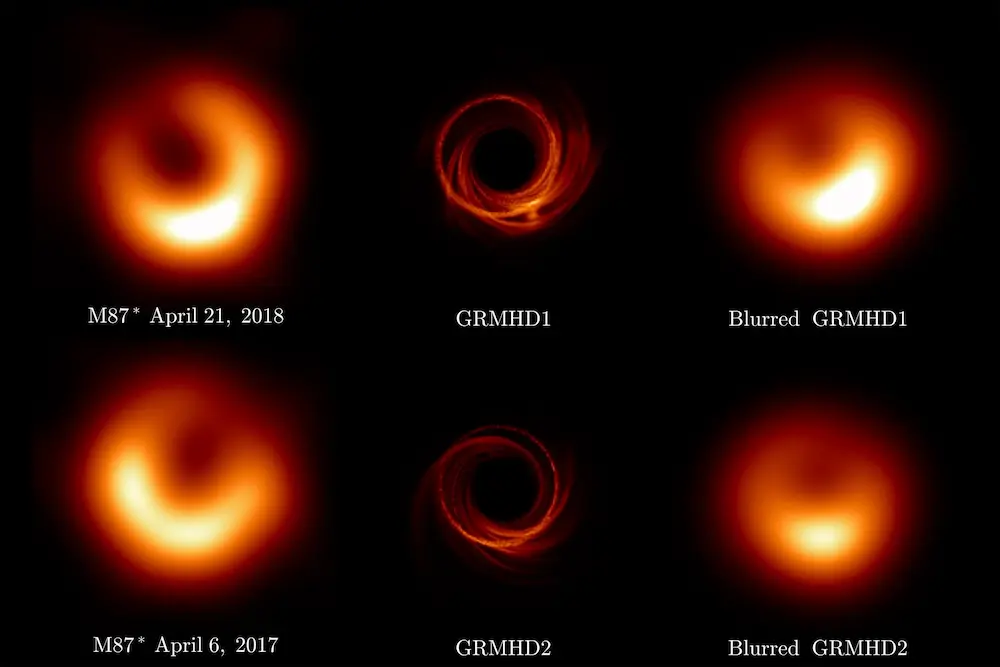
Then came the images, or at least the closest thing physics allows. The Event Horizon Telescope linked radio observatories around the world to create planet-sized resolving power, revealing the shadow of the black hole in M87* and later Sagittarius A*. These are not snapshots of the event horizon itself. Instead, they show glowing material in the accretion flow and the bright, distorted structure often described as a photon ring, shaped by light bent around the black hole before escaping towards us.
Those images matter because they test general relativity in one of its most extreme regimes. They also connect beautifully with the earlier evidence: X-rays from infalling matter, stars orbiting an unseen mass, gravitational waves from mergers, and now radio images of light skimming the brink. Different techniques, different messengers, one underlying picture.
Even now, black holes remain unfinished business for physics. Stephen Hawking’s predicted radiation, which would allow black holes to slowly lose energy, has not yet been observed. Questions about their inner structure and the information paradox still point to gaps between general relativity and quantum theory. That is part of the fascination. Future work aims for sharper horizon images, time-resolved movies of black hole environments and richer multi-messenger observations that combine light and gravitational waves.
Black holes began as a troubling feature of Einstein’s equations. A century later, they have become some of the clearest signposts we have for where physics is both triumphant and incomplete. The invisible has not just been inferred; it has been tracked, mapped, imaged and, in a sense, heard. And every new observation pushes us closer to the edge of what nature is willing to reveal.
ScienceDark matter is one of astronomy’s strangest facts: the Universe appears to be built on something we cannot see. It does not shine, reflect or absorb l…
Read more Science
The solar wind is the Sun’s constant outflow of electrically charged particles, an invisible stream that fills the solar system every day. For anyone …
Read more